The process as documented.
The process as lived.
Process Discovery reads your repositories and your event logs, reconstructs the process actually executed, confronts it with the documented process — then writes the approved reality back into your reference model. From a raw export to a human-approved model: one closed loop, fully audited.
Your repositories — Excel, Archimate, Enterprise Architect, Mega — are read and loaded into the graph. The BPMN 2.0 is generated on demand, in the chat.
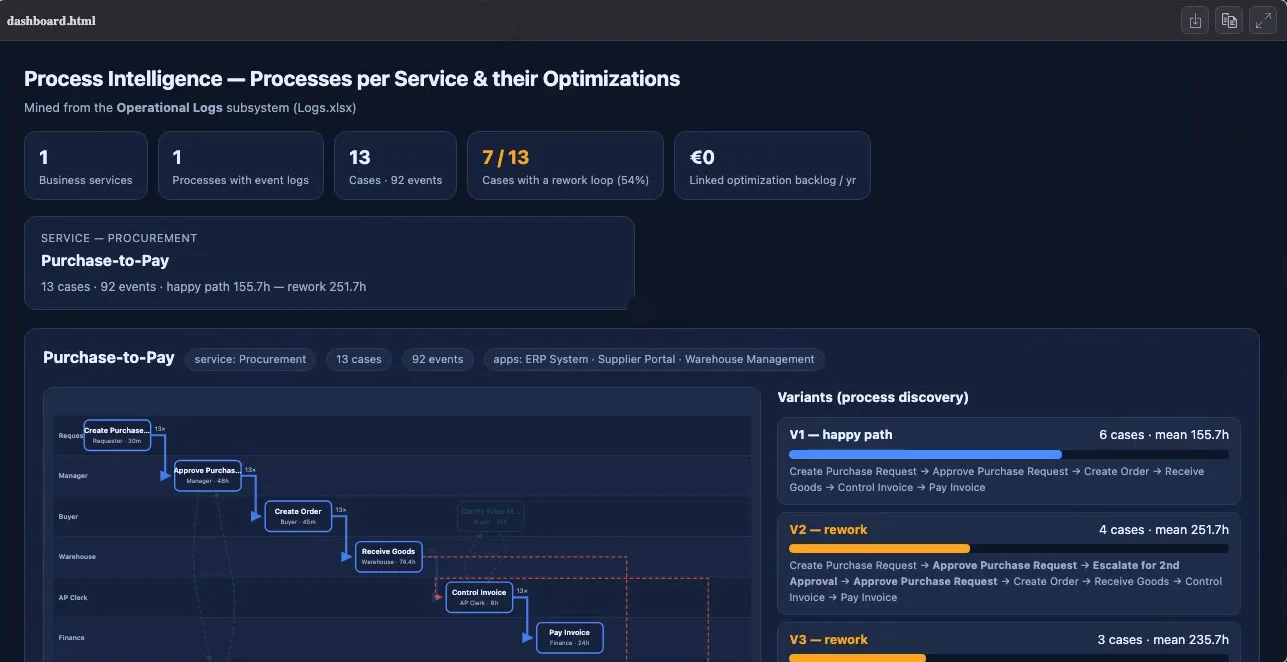
Process mining reconstructs the real flow from your event logs — including the loops nobody designed and the steps nobody performs.
Quantified gaps, argued optimization leads, and the approved reality written back into the reference model — the human validates, everything is traced.
Two inputs, one graph, zero invention.
The data feeds a knowledge layer — a graph the AI can query, but not invent. Deterministic algorithms compute the facts; the language model reasons on those facts, never on guesses.
First input: the designed process
Your process-management export — services, activities, roles, applications — is extracted and loaded into the graph, behind a confirmation gate.
Second input: reality
The event log — who did what, and when. Business-jargon columns are mapped by the LLM; the human approves the mapping.
Mining, deterministic
The miner reconstructs the real flow: variants, frequencies, durations, rework rates. Not an opinion — a computation, auditable.
From raw export to a validated model.
Four movements, always the same — and at every consequential step, a gate where a human decides.
Import the designed process
The import graph reads your export — Excel workbook, Archimate, EA, Mega — and extracts services, processes, activities, roles and applications. Nothing is written without confirmation. Then ask for the BPMN 2.0 in the chat: it is generated from the graph.
Mine reality
The event log comes in next — business-jargon columns, no imposed schema: the LLM proposes the mapping, the human approves it. The miner then reconstructs the flow actually executed, with the loops nobody had designed.
Confront and quantify
Variants, rework rates, durations — and the gaps that matter: the double approval that costs, the inspection step nobody performs, the clarification loop that drags. The AI drafts leads grounded in those numbers, rationale included.
Promote into the model
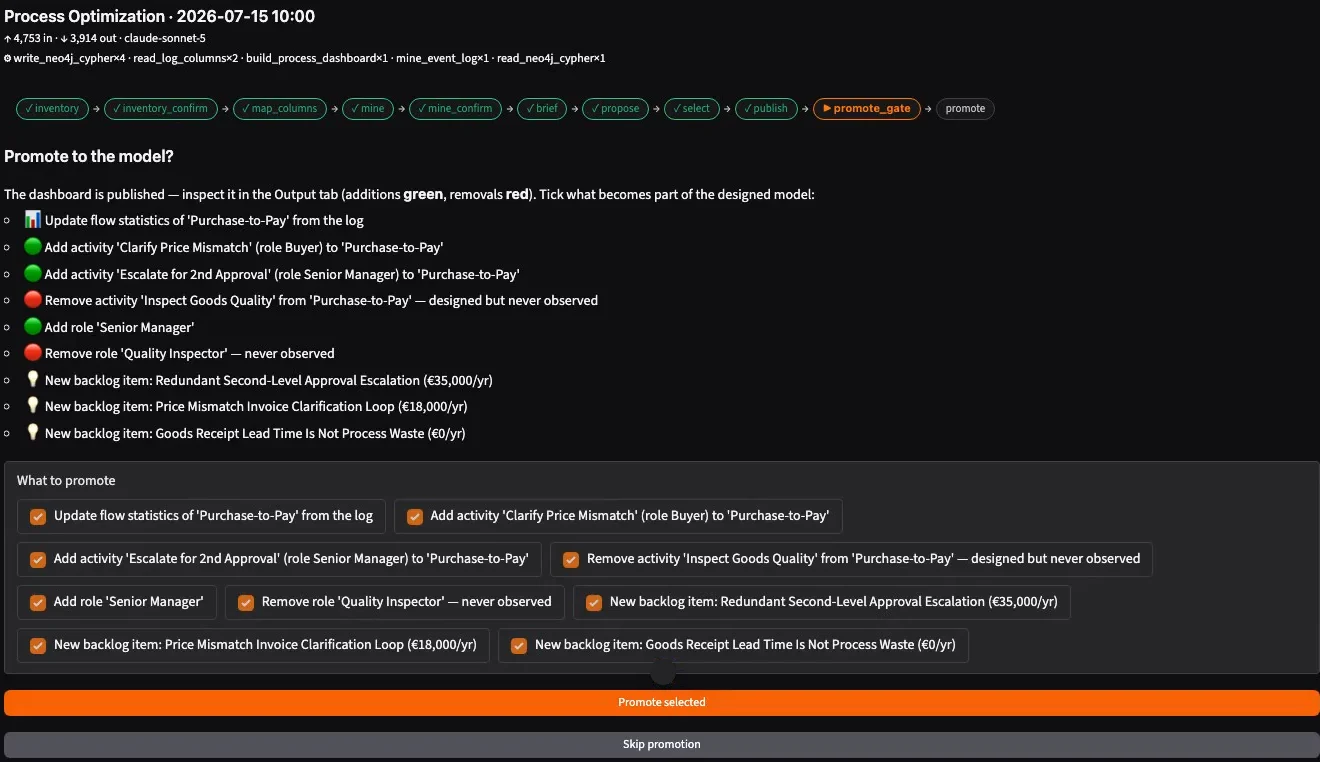
Item by item — additions in green, removals in red — the human decides what becomes official. The approved reality is written into the reference model, the BPMN is regenerated, and the optimization backlog is set down, quantified, ready to commit.
The evidence, on screen.
The promotion gate
Every step of the loop is a gate: inventory, mapping, discovery, briefing, publication — then promotion. Additions in green, removals in red, leads priced per year: nothing is written into the model without a human ticking the box.
- The prompt sent to the LLM is readable — and editable
- Every run is traced: model, tokens, tools called
- Recovery on incident without losing the thread
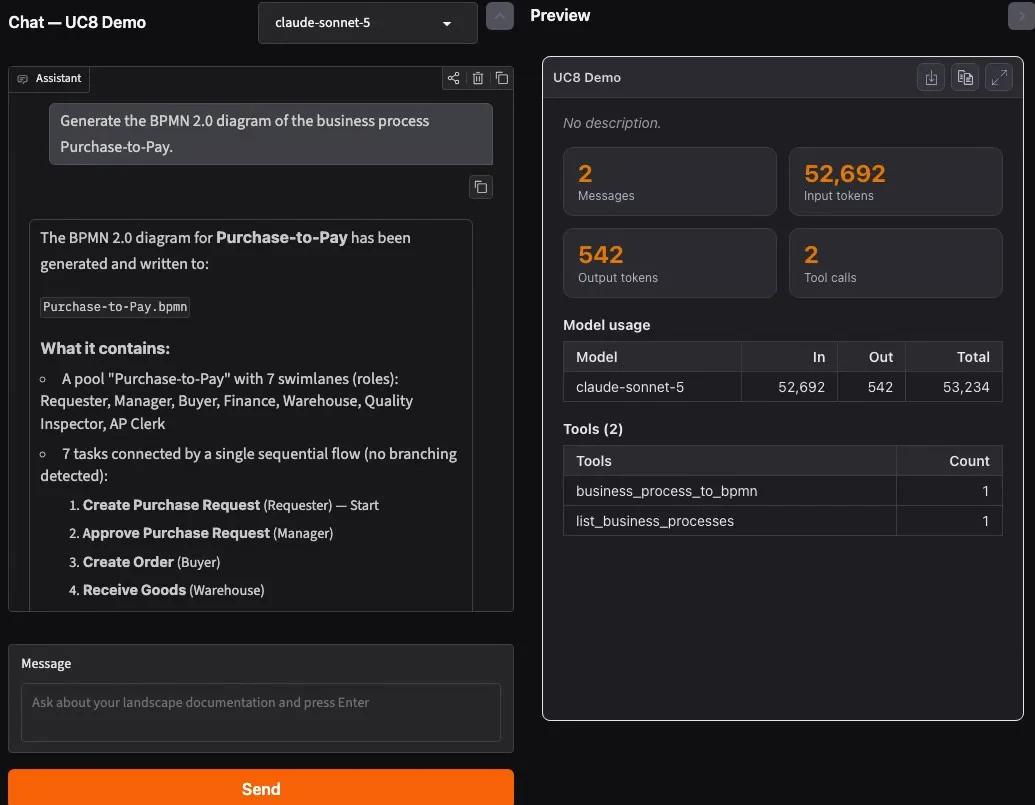
Ask, in plain language
"Generate the BPMN 2.0 diagram of the process." The assistant reads the graph — never its imagination — and writes the file: swim-lanes per role, tasks, flows. The repository's interactive view makes every node clickable.
- Standard BPMN 2.0, reusable in your tools
- Per-role views generated from the repository
- LLM usage and cost counters, always visible
A gate at every consequential step.
The run walks the gates one by one — and the dashboard is published only with what your experts have kept.
Inventory
Validate the scope: services, processes, activities loaded.
Mapping
The LLM proposes the log-column mapping — the human approves.
Discovery
The miner reconstructs the real flow, loops included.
Briefing
Variants, rework, durations — and the LLM prompt, readable and editable.
Publication
One checkbox per lead: the human chooses what is published — then promoted.
Your data stays yours.
Hosted in Switzerland
Data, compute and backups on AWS Zurich (eu-central-2) — one dedicated account per customer, nothing shared.
Encrypted everywhere
At rest with dedicated KMS keys, TLS 1.2+ in transit, private subnets — only the front door is public, behind a WAF.
AI without leakage
Models served through Amazon Bedrock, processed in the EU — your data is never retained, never used to train anything. A local LLM is possible in an isolated environment.
Named access
Accounts opened and closed on your request, MFA enforced — enterprise SSO available. Every action is audited.
Full export, anytime
Graph, BPMN and files in open formats — contractual deletion at exit (FADP/GDPR). No lock-in.
Portable to your premises
The same infrastructure (Terraform) can later be deployed in your own AWS account — the data moves as-is.
Born from the same engine
Process Discovery shares its platform with the other Ammelis products — same graph, same gates, same sovereignty.