Your ITFM tools say how much.
It explains why.
The Service Cost Optimizer connects every IT service cost to its applications, its capabilities and its owner — the BTM graph. Then it identifies qualified optimizations, has your experts validate them, and follows their delivery down to the realized run-rate. Alongside your ITFM/TBM tools, never instead of them.
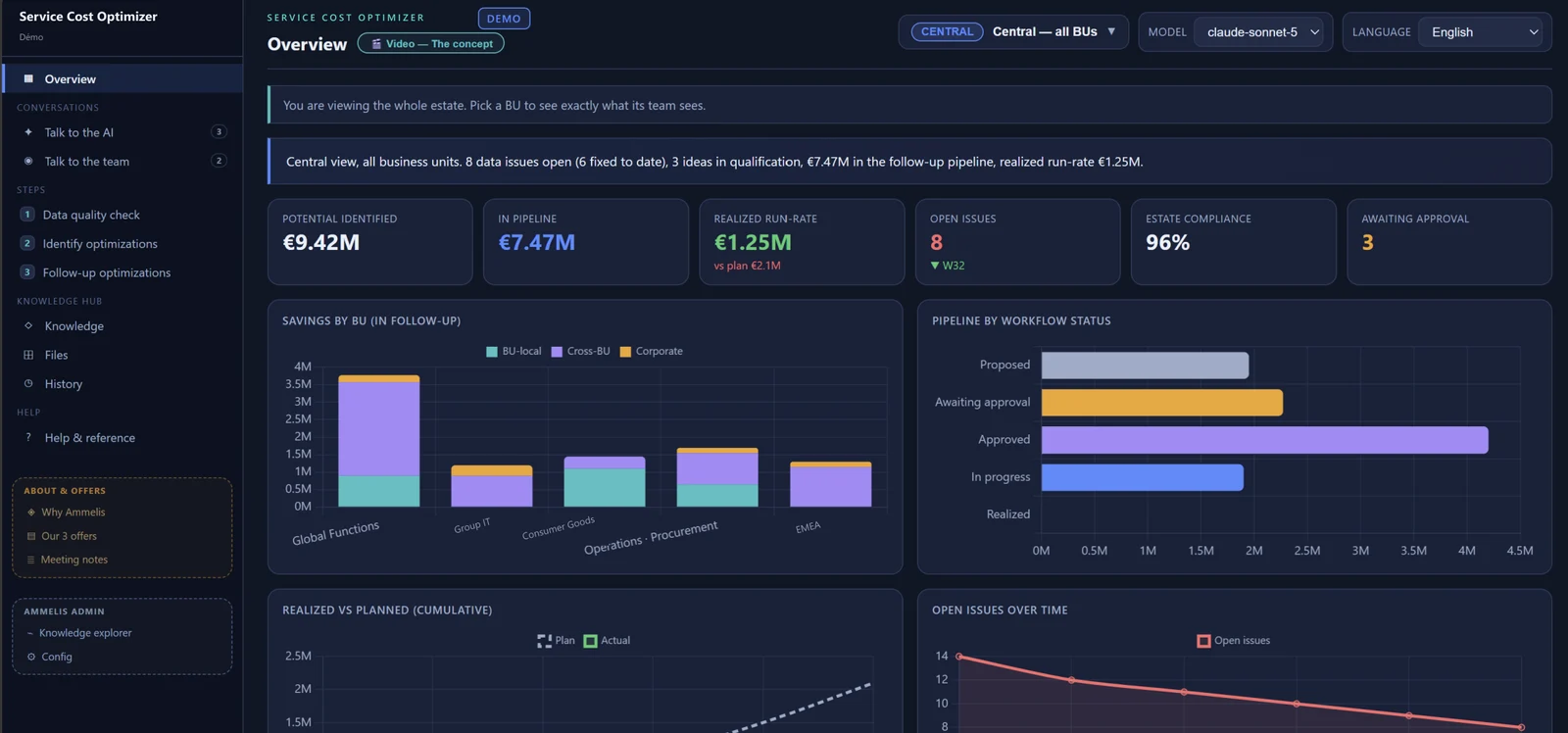
Your ITFM/TBM tools allocate the costs and produce the reports. They stay the source — the Optimizer reads their export.
Data imported and restructured into the graph, then interpreted: every franc is connected to what consumes it and to who answers for it.
Actionable recommendations, quantified and argued — a list a committee can act on, not a dashboard to interpret.
A graph that connects cost to what produces it.
The heart of the product is a BTM graph — Business-to-Technology Mapping — built from your service cost data:
The consumption chain, visible
Click any node and the chain lights up: you see where every franc actually sits — from service to application, from application to business unit.
An AI grounded in the graph
Answers are read from your facts, not generated out of thin air — temperature zero, and when the AI does not know, it says so.
Enriched by the market
Web search complements the graph: market price comparisons, alternatives, vendor risk — line by line, sources cited.
From raw data to realized value.
The product guides your teams along four workflows — each presented as a conversation with human validations, never as a black box.
Check data quality
Applications with no service, orphan costs, inconsistent referentials: the product detects the anomalies that distort your costs, proposes a relevant / not-relevant triage and tracks their resolution over time.
Identify qualified optimizations
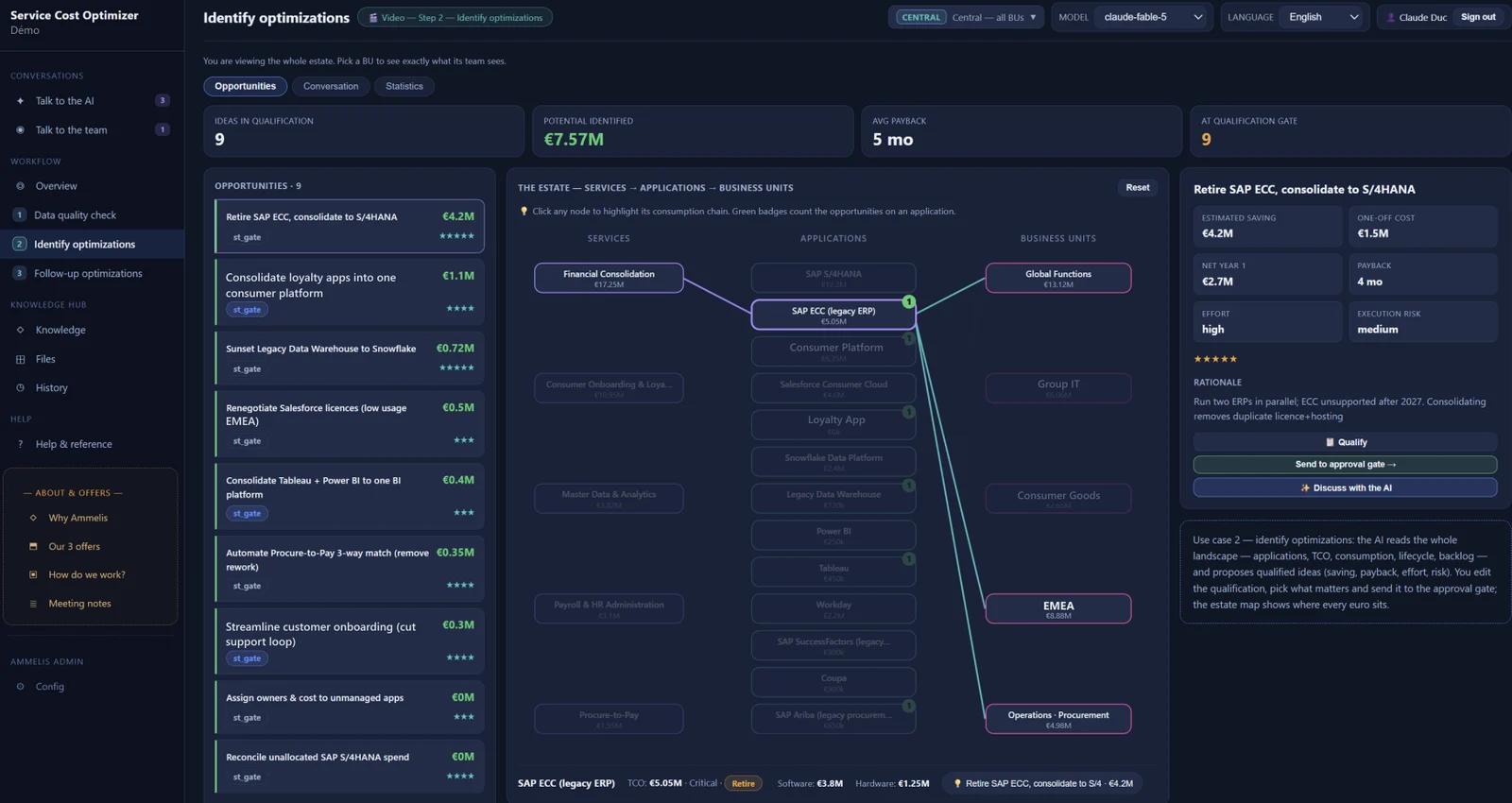
The AI reads the whole estate — applications, TCO, consumption, lifecycle, backlog — and proposes qualified ideas: estimated saving, one-off cost, net year one, payback, effort and execution risk, with the rationale written out. You edit, then send to the approval gate.
Follow up committed optimizations
Planned against realized, down to the observed run-rate: every approved optimization is followed from decision to delivery — the promised value is effectively delivered, and it shows.
Query the knowledge base freely
"Which applications have no service associated?" "Are we paying the market price?" Ask any question, in 7 languages — answers grounded in the graph, enriched from the web, sources attached.
The decision, on screen.
Identify optimizations
The estate map connects services, applications and business units. Every idea is qualified on a card — saving, one-off cost, net year one, payback, effort, risk — ready for the approval gate.
- The consumption chain lights up on click
- A list a committee can act on
- Discuss with the AI from any card
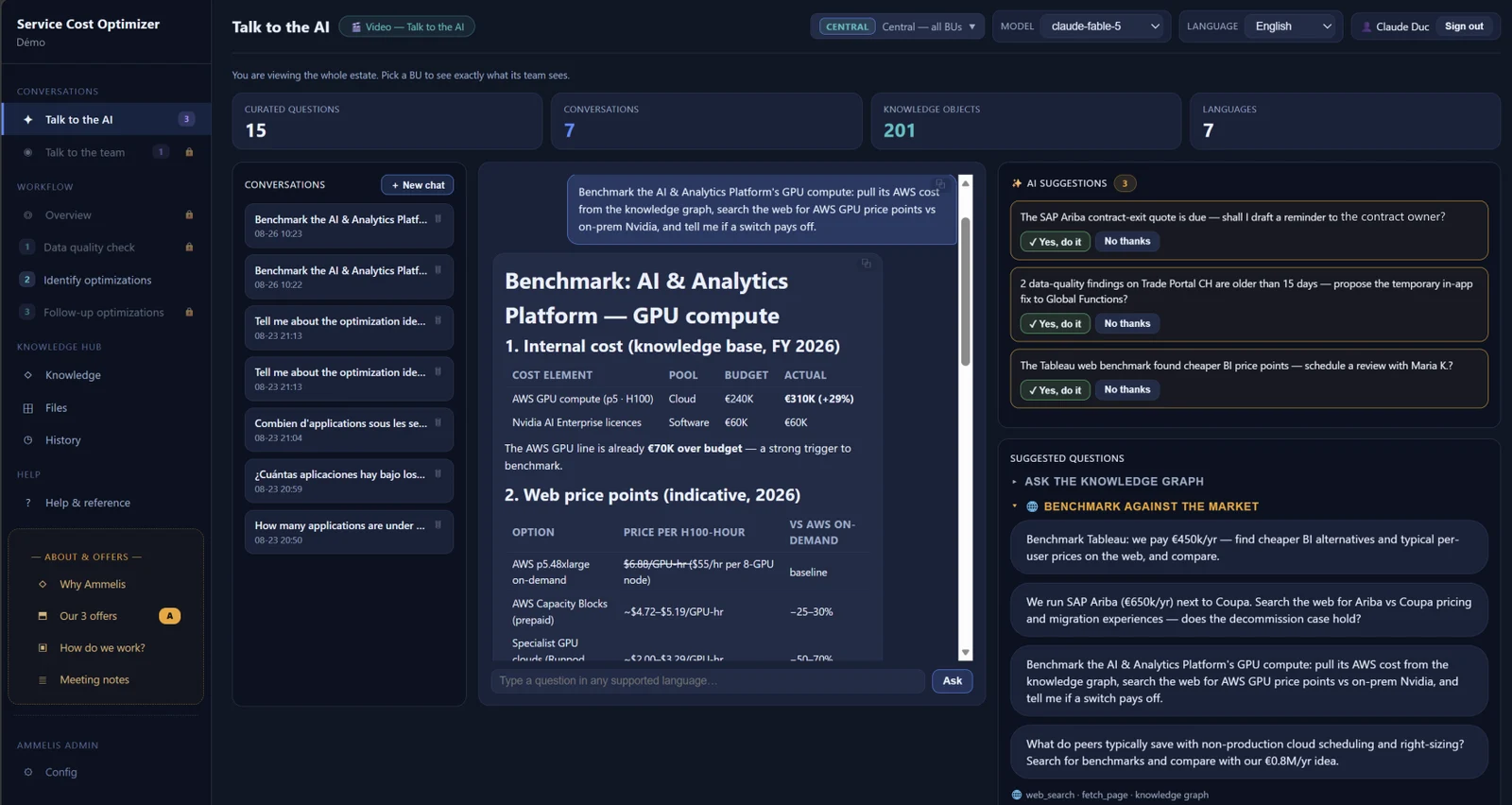
Talk to the AI
Ask for a benchmark: the internal cost is read from your graph, market price points are searched on the web, and the comparison comes back line by line — with the conclusion.
- Answers grounded in your facts, temperature zero
- Proactive AI suggestions, to accept or decline
- 7 languages, several models to choose from
- And when it does not know — it says so
A guided conversation, not a black box.
Every workflow runs through the same steps, presented as a conversation — and at every gate, a human validates.
Framing
The question is sharpened with you — scope, units, horizon.
Proposal
The AI reads the graph and proposes its leads, argued.
Selection
Your experts keep, correct or discard — in the loop.
Generation
The deliverable is produced: cards, reports, summaries.
Costing
Saving, payback, effort, risk — set down in black and white.
Your data stays yours.
Hosted in Switzerland
Data, compute and backups on AWS Zurich (eu-central-2) — one dedicated account per customer, nothing shared.
Encrypted everywhere
At rest with dedicated KMS keys, TLS 1.2+ in transit, private subnets — only the front door is public, behind a WAF.
AI without leakage
Models served through Amazon Bedrock, processed in the EU — your data is never retained, never used to train anything.
Named access
Accounts opened and closed on your request, MFA enforced — enterprise SSO available. Every action is audited.
Full export, anytime
Graph, database and files in open formats — contractual deletion at exit (FADP/GDPR). No lock-in.
Portable to your premises
The same infrastructure (Terraform) can later be deployed in your own AWS account — the data moves as-is.
Born from the same engine
The Optimizer shares its platform with the other Ammelis products — same graph, same validation gates, same sovereignty.